Tom Taylor's Friendly Neighborhood Spider-Man Review
Why are we here again?
Amazing Spider-Man #1000 drops this September. Before then I want to have read every Spider-Man comic that fed into it. I should be reading Non-Stop Spider-Man for that goal. But I ended up re-reading Tom Taylor’s Friendly Neighborhood Spider-Man due to a panel I saw on Reddit. It ran for 14 issues in 2019-2020, which ran during the Nick Spencer Amazing Spider-Man era.
People have a lot of strong opinions on Tom Taylor’s writing. Taylor’s Injustice, especially Year One and Year Two, is one of the books I have reread again and again. Taylor took material that was supposed to be a tie-in for a fighting game with a weird, maybe even flawed premise and made it something that still holds up. I recall so many moments from the stories vividly, even though it’s been half a decade since I read any of it. The first stretch of DCeased is also peak. In recent times, his writing does flanderize the characters and the beats become slightly predictable. One common criticism that follows Taylor around is his work being “preachy”. He writes Peter and May calling out wealth privilege, helping the homeless, raising money for shelters. I don’t have a problem with that. Comics are read by kids. If a kid reads this book and absorbs that “having means to help creates an obligation to help”, that is a good message even when it lands with a hammer. The mechanic of how a message is delivered is a separate craft question, and while I have some critiques there, the fact of having a message is not preachiness. It’s just having one. All art has a message.
What works: who Peter Parker is
The thesis of this run is that Peter is who Ben and May made him, a good neighbor, a good friend and a good son. He will always help people, no matter the cost and without any upside.
Flashbacks to Ben and May feeding a homeless man. Present-day scenes of May organizing rebuild fundraisers for F.E.A.S.T., the shelter she volunteers at and Peter helping people in the neighborhood not because there is a crisis but because they are his neighbors. This is the same flashback structure Joe Kelly is using in Amazing Spider-Man Vol 7 (2025), which is no accident. Both writers are reaching for the same idea, that Peter is the boy Ben and May raised.
Taylor’s mechanics here are not always to my taste. I disagree with some of the on-page advice, such as giving cash to someone without understanding if they would use it responsibly. That is a worse intervention than giving food, or just having a conversation to see what they need. My dad, bless him, goes to the local market at times and asks young, poor kids what is stopping them from getting an education, what do they need. That is the move I’d argue for. But Taylor’s present-day homeless scenes are stronger than his flashback prescriptions. Peter just hangs out with these folks, helps them with food and when the neighborhood is in trouble they show up too. The message is that if you help people, those people will help others. Kindness compounds and cascades.
The kindness and compassion beats recur throughout the run, at least once an issue, if not more. That is what makes this book Friendly Neighborhood Spider-Man.
What works: shared universe and humor
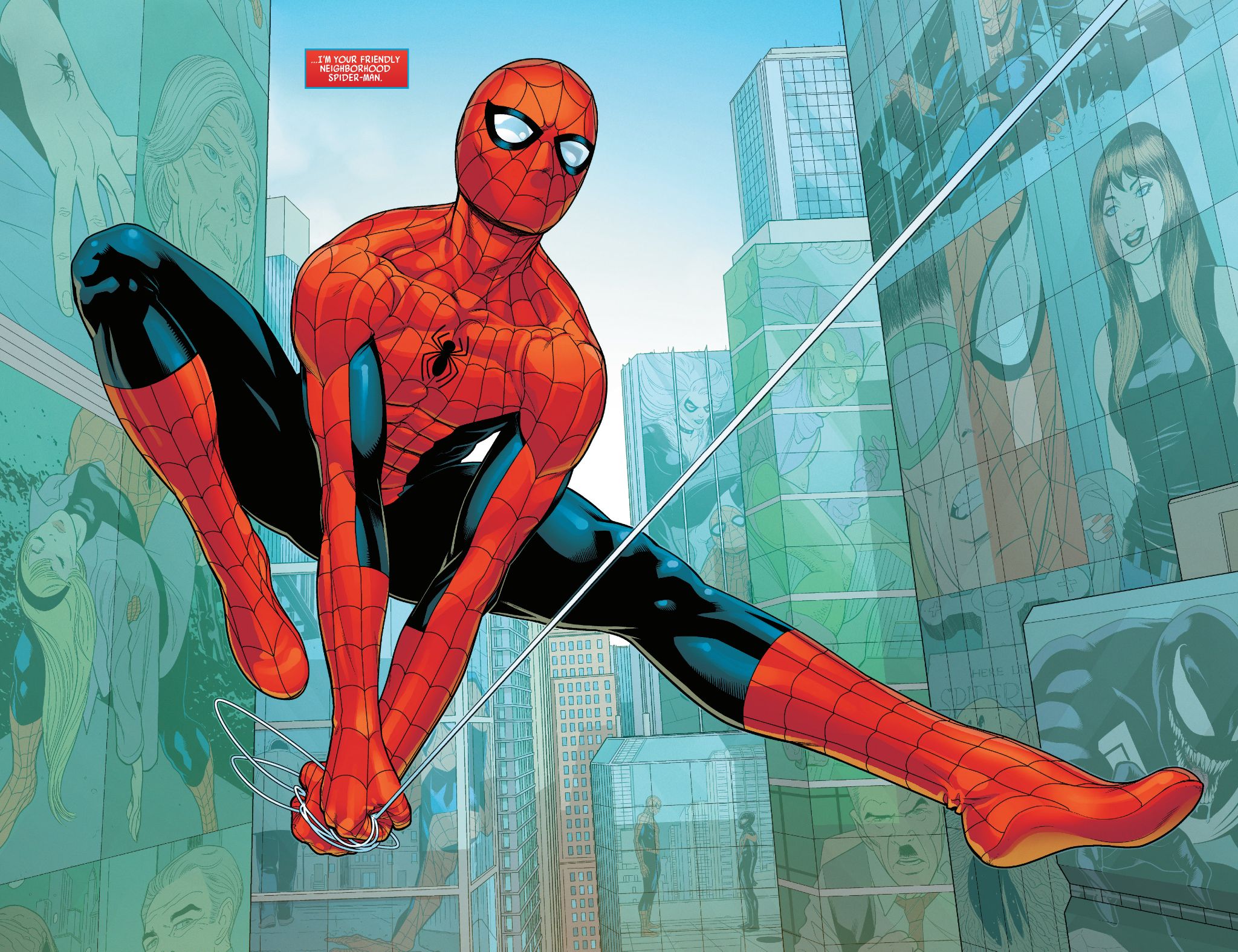
Taylor uses the Spider-Man cast of characters without overstuffing the book. Mary Jane, Miles Morales, the Fantastic Four, Boomerang (alongside the new character of Rumor). Each gets the right amount of page time for what their cameo is supposed to do.
They all anchor the run in a specific Marvel moment, which I appreciate. It makes the book actually feel like a shared continuity book and dates it. FNSM Vol 2 takes place during the Kingpin-as-NYC-mayor era, when Peter is living with Boomerang (whose scenes always make me crack up) and Taylor uses those events as well as ongoing main universe events like War of The Realms seamlessly in the book.
The humor is top-notch and delivered well, which is a requirement for a Spider-Man comic. The running gags, such as the Under York kids knowing the Human Torch but not knowing Spider-Man (hilariously pissing Peter off) and Peter pretending to be incompetent to Detective Stebbens, are really funny.
What works: the single issues
The single-issue stretches between arcs are the peak of the run.
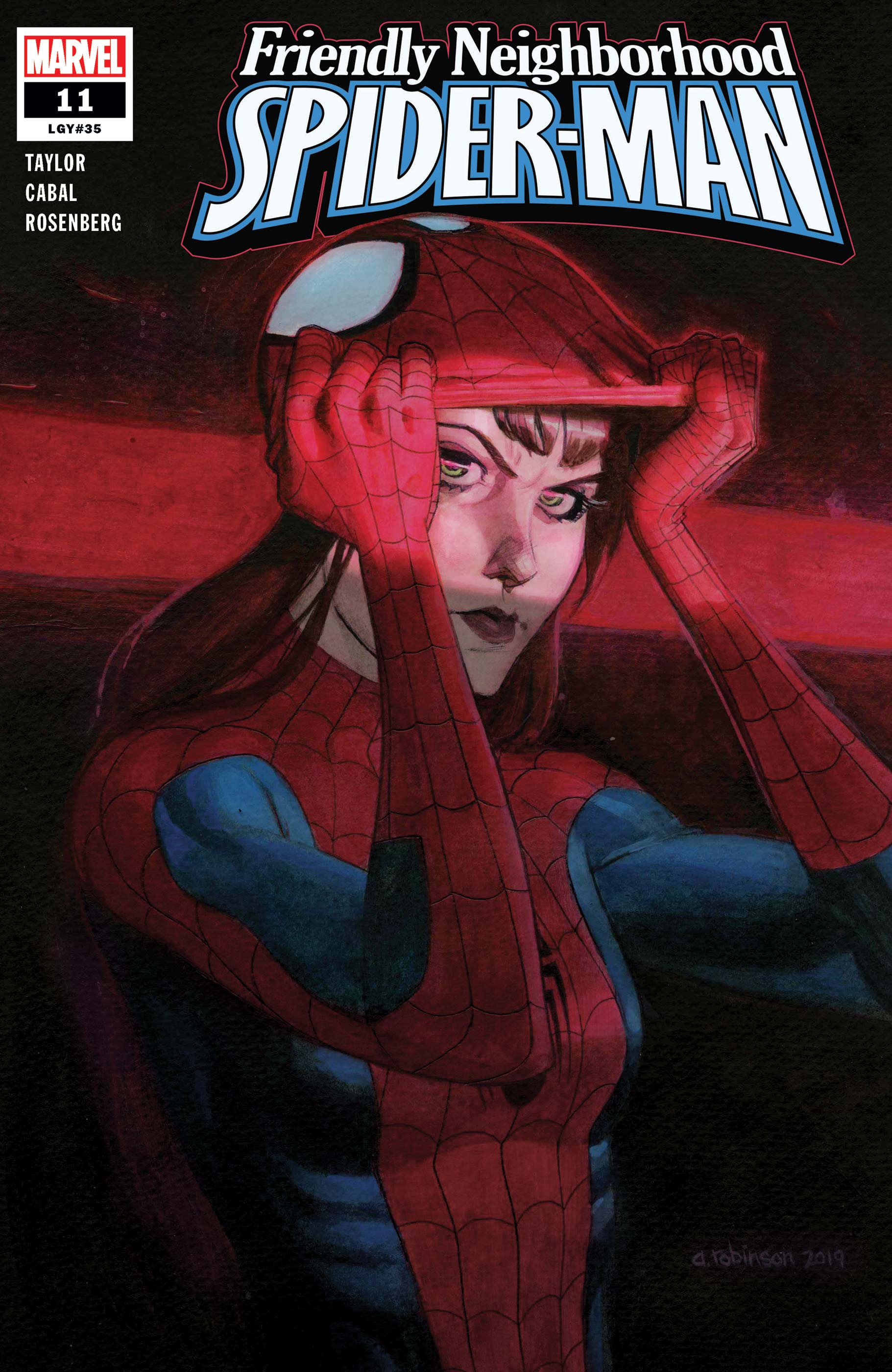
Issue #11, The Mary Jane centric issue is the best one. The script is structurally symmetrical: the issue opens and closes with the same beat between Peter and MJ, but their roles are reversed by the end. In-between, we see how MJ handles things when Peter is out of commission, which means supporting Peter’s family when he is not around and even protecting NYC. The line “Spider-Man is Peter Parker, and Peter Parker is my responsibility” is the issue’s thesis and it is a great one. Taylor’s quippy register works especially well with MJ because she is the easygoing one, who never sweats things.
The terminally-ill-child issue is a spiritual successor to the legendary Amazing Spider-Man #248, “The Kid Who Collects Spider-Man”. Taylor’s version is in the same vein: Spider-Man spends the day with a dying kid. What it does better than the original is let the kid actually be a kid. The child has tantrums. The parents have their own stress response. There is a stretch in the middle where the book gets uncomfortably real.
If the rest of the run hit at this level, FNSM Vol 2 would be a top-shelf recommendation.
What doesn’t work: the rushed ending and some character work
This is where the run’s ambitions and its commercial reality collide.
Rumor is the new elderly female neighborhood superhero who turns out to be central to the Under York arc. Her identity-reveal mechanic is genuinely clever: she suspects Peter is Spider-Man because he helps her lift something visibly heavier than a non-super person should be able to lift, and she follows the thread to spy on Peter to figure out Peter’s identity. I love writing where characters actually think. That is the right way to do an identity-figured-out moment.
The problem is everything around the reveal. Rumor has decades of history with Captain America and the broader history of NYC superheroes, but has never been mentioned before in any comic. She just shows up as Peter’s neighbor. And the woman who needs Spider-Man’s help in the inciting incident also turns out to be central to the Under York mythology and happens to live in the same building. Two of Peter’s neighbors are randomly tied to the same secret-civilization plot, and one of them is a superhero who has apparently been around forever but conveniently never mentioned. That is a stack of coincidences plus a touch of Mary Sue energy on Rumor.
I think the fix is small. Have Peter and Rumor meet somewhere else. Have her figure out his identity. Then have her become his neighbor. The accident of her being near him is a contrivance.
The Under York conclusion gets crushed by the cancellation. This is the second-to-last issue of the run, and it is exactly the kind of compressed-final-issue you have seen in every cancelled comic. Taylor had clearly planned a longer arc to build out Under York’s mythology, and when the book got cut he had to wrap it in one issue. Rumor is absent from the conclusion, which is bizarre! Why wouldn’t Peter call his neighbor who has the entire history with this conflict? The Fantastic Four show up, which is great because they are Peter’s family, but the issue is very rushed. It is hard to do endings well, and this one didn’t for me, even though it hit all the beats because of the pacing issues.
The Prowler/Helminth arc is the bigger of the two misses. Two problems:
- Character voices: Hobart “Hobie” Brown (the Prowler) and Peter have built years of mutual trust. Peter (very close to the point in time this arc was going on) asked Hobie to pose as Spider-Man during the Parker Industries era. Taylor reverts the relationship to an older, less stable state, which doesn’t track. Hobie is more hot-headed and Spider-Man randomly breaks into Hobie’s house with unnecessary force. Continuity-breaking can happen in serialized storytelling, sure, but Taylor is the writer who proved with the rest of this run that he respects continuity. So the deliberate reversion just to manufacture conflict reads as a miss.
- Another coincidence stack: The villain has a relation to Rumor that is essentially “two villains in a row are tied to this character’s history.” Prior nonexistence plus sudden centrality is very off-putting.
The Helminth arc has a decent ending but it’s definitely the weakest story here, by far.
The heart: Aunt May
Aunt May is diagnosed with breast cancer, and this is the emotional through-line of the whole run.
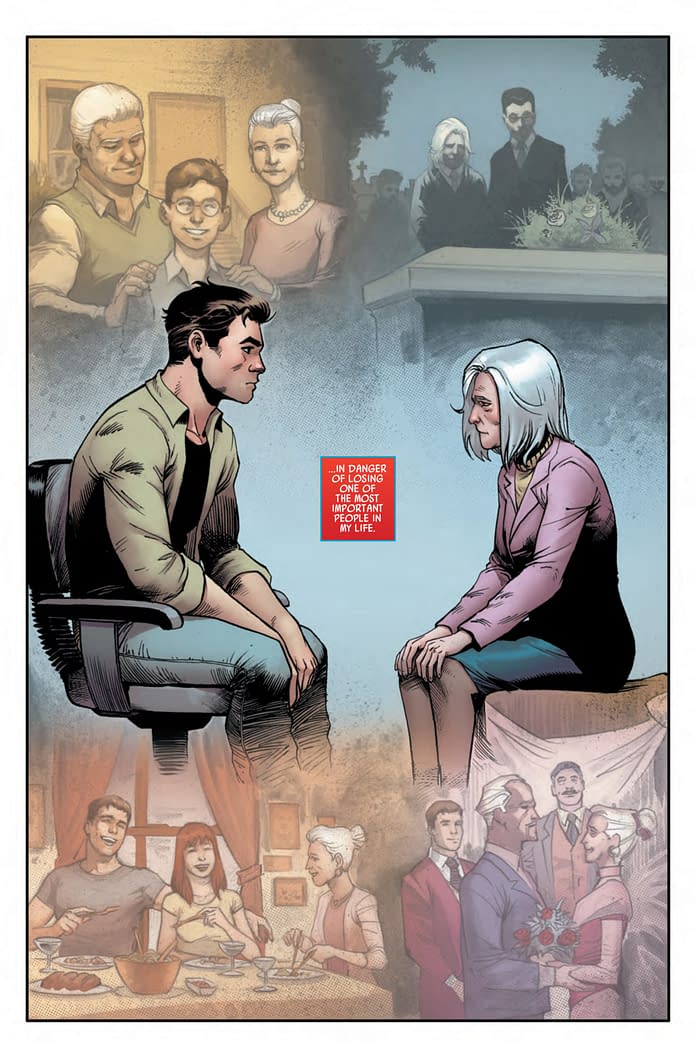
I can relate to this. My own mom had to undergo heart surgery a couple of years ago and there were stretches where it was worrying and dicey. So when Peter says, in the diagnosis scene, “My spider-sense should have been going off for five minutes. Because I’m in danger. In danger of losing one of the most important people in my life,” I felt that line.
What works in this arc:
- May’s response, which is to roll with it and try to manage everyone else’s feelings, is exactly in character.
- MJ steps in to be the family while Peter is out of commission.
- The nurses calling Peter “May’s son.” Small detail, big punch.
- The surgery to remove the tumor as the climax of the run is the right structural choice. The Under York stuff resolves before the surgery as the plot’s climax. The surgery is the emotional climax.
What doesn’t work:
- Peter telling May he is too busy to come to her chemotherapy when he hears the news is out of character. I get that Taylor needs to manufacture conflict and make Peter show up later. May herself was not going to provide any conflict, she just accepts Peter’s behavior, trusting that there will be a reason (another thing this run has in common with Joe Kelly’s run) but having Peter dodge chemo by claiming he is busy is out-of-character to an extreme. He may have vented his emotions outside later, but in front of her, he would only support her.
A dock on an otherwise excellent emotional arc.
The verdict
A solid 8.5 out of 10. On characterization specifically, more like a 9. Taylor is dialed in on who Peter is, on the supporting cast voices, on the moments that make Spider-Man Amazing, Sensational and Spectacular.
I’d recommend this as a modern Spider-Man entry point, especially for readers who can’t get past the art/writing style of older books (Lee/Romita Sr. still works for me, but I know that is not everyone.) and have read the obvious suspects (Spider-Man Life Story etc.). Short, complete-ish, emotionally legible, with a few genuinely great single issues threaded through it. Friendly Neighborhood Spider-Man by Tom Taylor gets a recommendation, with the caveat that it’s an uneven run.
Onto the next one.
Comments
No GitHub? Email me.